
Southington Past Residents by Era
Previous residents leave different traces depending on the period and the question. A deed can show a conveyance, a directory can show a listed association with a house, and a census can show a household on one enumeration date. A permit can date work on a structure without proving who lived there. Begin with a current identifier, then select the source whose dates and fields fit the gap.
| Source | Years It Covers | Where Held | What It Shows |
|---|---|---|---|
| Southington land records | Local records begin 1779; exact online cutoff needs verification | Town Clerk, RECORDhub, physical books | Deeds, mortgages, liens, maps, legal descriptions, recorded parties |
| Vision parcel and sales history | Current card; sample includes a 1991 sale reference | Southington Assessor database | Current tax ownership, situs and mailing address, sale and value history |
| GEMs tax file | 2025 payment context, dated December 31, 2025 | Tax Collector search | List number, billed address, bill fields, payment history |
| Southington directories | 1869-1962 series cited; 1882 confirmed, individual years verify | Library and archival shelves | Name, occupation, house or boarding clue, street and village wording |
| Reverse or criss-cross directories | Exact local years are not posted | Library Local History Room | Address-to-occupant path for a dated volume |
| Federal census | Public through 1950 under the 72-year rule | National Archives and library databases | Household names, ages, relationships, birthplace, occupation categories |
| Sanborn maps | 1884, 1890, 1895, 1901, 1906, 1911 located; NPS map era through 1948 | Library of Congress and local collections | Building footprint, use, street context, not a resident list |
| Building permits | Current and older history in City Squared; older records are being added | Building Department | Permit, inspection, certificate, and construction-document dates |
| Vital records and newspapers | Various years; access depends on event and record type | Town Clerk, DPH, library, archives | Birth, death, marriage, obituary, spouse, heir, and address clues |
| Probate | Public case data from 2011; archival groups 1825-1973 | Cheshire-Southington Probate and State Archives | Estate dates, fiduciaries, heirs, and case leads |
The era table is a routing tool, not a claim that every row is complete online. The official RECORDhub date-availability rows did not populate in the inspected session. The directory series has gaps that must be checked on the shelf. A research note should say which date is confirmed, which is a lead, and which office can settle the question.
Southington Previous Residents: Vision First
Start the backward trail with the current address in the Vision assessor database. Save the location or situs, mailing address, owner and co-owner fields without reproducing private names, PID, MBLU, account/List#, assessed and appraised values, building and land details, outbuildings, valuation history, sale date, and book/page. These fields help connect a current parcel to an older instrument without assuming the tax card is a history of every household.
The inspected sample uses PID 12734 for 437 HOBART ST, MBLU 123 / 084, and account 8556. Its ownership-history area contains a 1991 sale reference and book/page 0515/0244. That reference is the useful bridge. The sale price and date are not the same as a recording date, and the owner field is not an occupant finding. A different mailing address can be a clue about the tax record without explaining who used the property.
Run an address, owner, account, MBLU, PID, or All search in Vision's Southington property database. If a typed address fails, use Street Listing and browse alphabetically. Preserve the source's spelling and labels before moving to the deed index. A name variant, spouse, trust, or parcel split can make a simple repeat search look like a break in the chain.
- Parcel
- A mapped assessment unit identified by local keys such as PID or MBLU.
- Situs address
- The location assigned to the parcel, which may differ from an owner's mailing address.
- Book and page
- A recording reference that helps the Town Clerk or RECORDhub locate an instrument.
- Sale history
- A parcel-card record of a transaction or reference, not a complete list of residents.
Southington Past Residents in Deeds
Use the book/page from the current Vision card to find the related Town Clerk instrument. The grantor is the person or entity conveying an interest. The grantee receives it. A chain of title is the sequence of recorded conveyances that connects one legal interest to earlier ones. The legal description matters because an old deed may use a subdivision lot or metes-and-bounds description instead of the street number used today.
- Record the current Vision identifiers, owner and co-owner spelling, mailing and situs labels, sale reference, and book/page.
- Search RECORDhub by the available name or document clue, or take the book/page to the Town Clerk. Record the instrument type, grantor, grantee, recording date, legal description, prior reference, and image details.
- Search the prior grantor as a grantee in the next older conveyance. Try initials, spouse names, trusts, and spelling variants when the first query does not connect.
- Compare the legal description, subdivision or map reference, parcel identifiers, and neighboring names. A parcel can merge or split, so a street number alone is not enough.
- When the online trail stops, ask for the physical deed book, map, or archive finding aid. Continue only when the legal description supports continuity.
The deed chain can show ownership transfers and legal relationships. It cannot, by itself, prove that a grantee slept at the address or that an owner remained there between recordings. Pair it with a dated directory, census, obituary, permit, or other source that answers the household question.
Southington Previous Residents Online Cutoff
Southington's current land-record portal has two important metadata dates. The no-subscription index and image service begins March 23, 2020 in the public plan metadata. A separate Land Records subscription begins February 20, 2021. These dates describe portal plans, not a complete statement of how far back Southington books or images exist. The exact index-from and image-from rows on the date check did not render, so a historical search should confirm the cutoff with the Town Clerk.
The image below comes from the Southington RECORDhub subscription metadata. It shows why an index result, image access, watermark, and print setting may follow different paths.
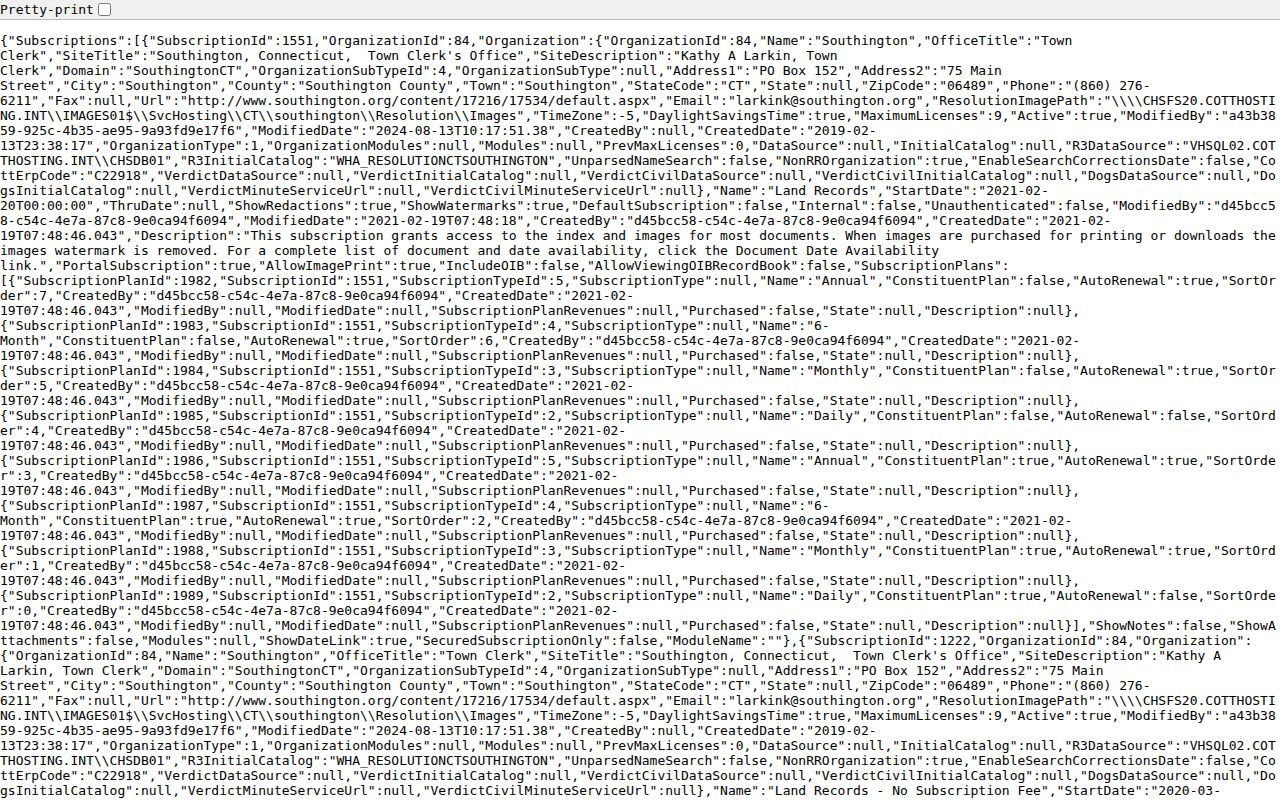
The plan display is useful for understanding access, but it is not a substitute for reading the deed or asking the local recording office about an older volume.
The public RECORDhub date-availability page is the right place to recheck index and image ranges when the portal supplies rows. The capture below preserves the date-check route even though the automated session returned empty rows.
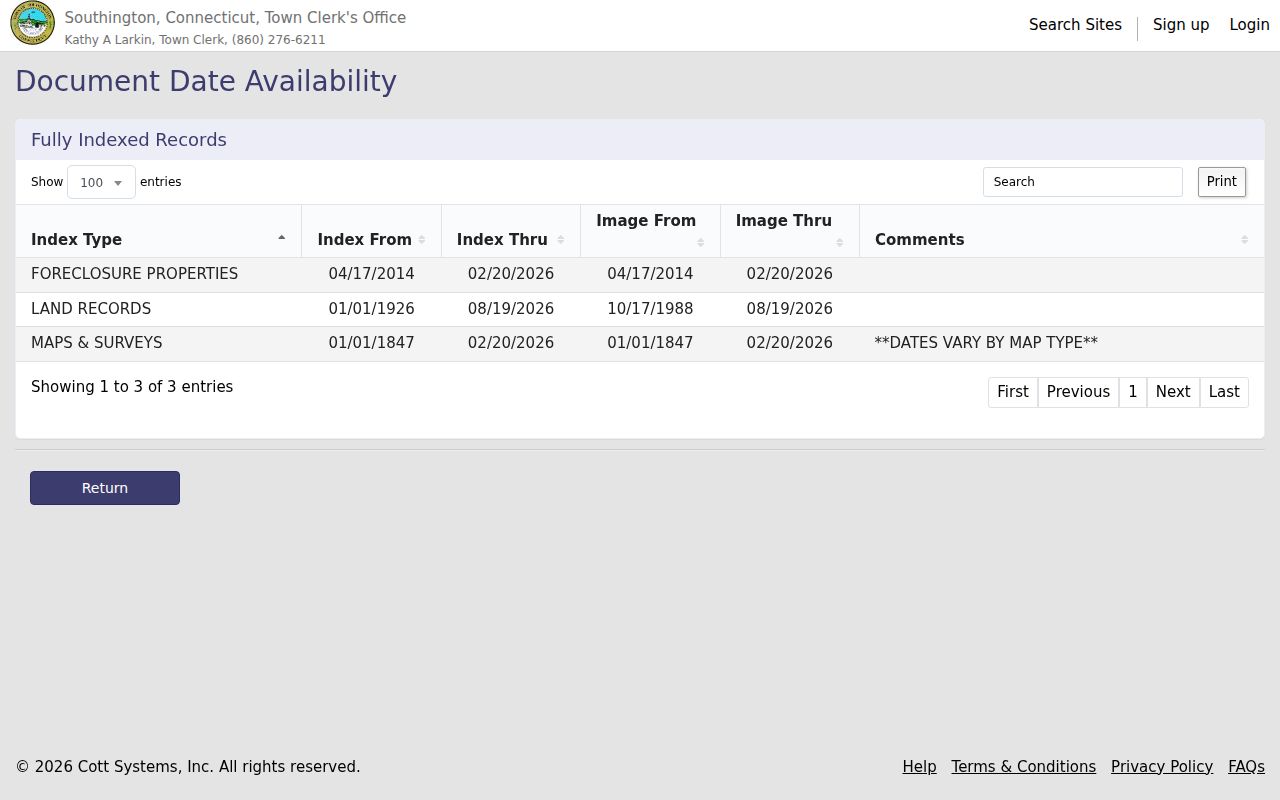
Until those rows are confirmed, describe the online boundary as unknown and move to Town Clerk books, mail, fax, or a focused record request.
The Southington Town Clerk land-record guidance supplies the local fallback. Its copy process uses six volume/page pairs, special instructions, and mail or fax delivery. Copies are $1 per page; mail requests go to PO Box 152 with payment and a stamped self-addressed envelope, while fax requests use (860) 276-6229. No processing-time promise was documented. The clerk counter at 75 Main Street and phone (860) 276-6211 are the best route when a deed reference is incomplete.
Southington Past Residents in Directories
Previous residents are often visible first as a name and address association rather than a legal owner. The National Park Service bibliography cites Southington directories from 1869-1962 and confirms an 1882 volume. Individual catalog years need verification. A directory entry can show a name, occupation, house or boarding notation, street clue, and village abbreviation. It may say Plantsville, Milldale, or Marion where a current address record uses Southington.
- Write down the old street wording, number, village shorthand, occupation, household notation, and the directory year.
- Check the nearest earlier and later volume. Keep spelling variants and note a move between Southington center, Plantsville, Milldale, and Marion.
- Pair the directory with the nearest public census year: 1850, 1860, 1870, 1880, 1900, 1910, 1920, 1930, 1940, or 1950.
- Compare household names, ages, relationships, birthplace, and occupation categories without treating a decennial snapshot as annual proof.
- Use the deed, assessor sale history, newspaper, probate, and vital record routes to test an ownership or family event.
The Local History Room and the Connecticut State Library can confirm whether a particular year is actually held. The collection shelf and how to read its abbreviations are described once on the Southington Directory Book page. Here, the focus stays on pairing a dated listing with a dated household record so that previous residents are not inferred from a single line.
A directory tells the researcher that a person was listed or associated with a place in that volume. A census gives a household snapshot. A deed gives a legal transfer. Those source roles should remain separate in a house-history note.
Southington House History at the Library
Southington Public Library's Local History Room at 255 Main Street is non-circulating and used in the library. Listed hours are Monday through Thursday 9:00 a.m. to 8:00 p.m., Friday 9:00 a.m. to 5:00 p.m., with weekend closure; the Reference Desk is extension 5 at (860) 628-0947. Staff can pull books, maps, phonebooks, directories, reports, photographs, newspapers, obituaries, and organizational records. Fragile material may have copying limits.
Library collections include Southington High School yearbooks from 1951-1989, the Lewis High School Chronicle from 1926-1990, The Emblem from 1911-1975, school reports, association registers, cemetery and memorial records, and local history folders. The library's genealogy resources also provide in-library Ancestry access and point to census, vital, land, probate, military, and newspaper material. These collections can reconnect a former classmate or explain a family link without claiming a current address.
When local shelf material needs context, the Southington Historical Society at 239 Main Street and the Barnes Museum at 85 North Main Street are additional research stops. The Historical Society's library covers local, ethnic, and family history. The Barnes Museum holds documents and archives tied to local material culture. Contact staff before assuming an item is on an open shelf.
Use the library's Local History Room description for current access rules. It is a practical human-use layer in a previous-residents search because staff can connect a street clue with the right yearbook, newspaper, map, or local file.
Southington Previous Residents and Sanborn Maps
Sanborn maps answer a built-environment question. They can show a footprint, use, street relationship, and building context for the date on the sheet. They do not name a resident or establish title. The Library of Congress has individually located Southington records for 1884, 1890, 1895, 1901, 1906, and 1911. The National Park Service bibliography describes a map era extending through 1948, but later scans need separate verification.
The Library of Congress 1895 Southington Sanborn record is a useful example because it identifies a dated map set and sheet context. Pair the sheet with a directory year, census household, and deed legal description. If a current parcel does not line up with the old street wording, compare the map, village label, cross street, and legal description rather than drawing a new boundary from the image alone.
A strong house-history note says what the map establishes, what the directory establishes, and what remains uncertain. That discipline helps when a building changed, a parcel split, or a street number no longer matches the older source.
Southington Past Residents in Permits and Probate
City Squared supplies an address-linked permit and property-history route through the Southington Building Department. Use the upper-right property lookup with the street number and name, leaving off the suffix. The town says most history is visible and older documents are being added. Registration is required for applications and document uploads. A FOIA request is the fallback for additional or open-permit clarification. A permit can date construction, alteration, inspection, or a certificate, but the applicant is not automatically a resident.
Newspaper notices and obituaries can connect a person to a spouse, child, church, veterans group, former address, or estate transition. The library points to the Southington Citizen archive, Record-Journal material, and Historical Newspapers of Connecticut. Oak Hill Cemetery, historic since 1733, has a search and find-a-grave route at 95 Flanders Street, (860) 628-0643. St. Luke Church at 99 Bristol Street, (860) 628-4713, is a parish and cemetery-contact lead. Burial or an obituary is not the same as residence at the time of death.
For estate questions, the Cheshire-Southington Probate lookup has public case information from January 5, 2011, while State Library and Archives material reaches into probate groups from 1825-1973. The public row can identify a case number, decedent, type, district, and status. Document access is more limited and can require an interested-party process. Use probate to identify a lead, then ask the court or archive for the correct access route.
The Building Department guidance and the library's local-history collections belong beside deeds and directories, not in place of them.
Southington Address History by Village
Southington's villages create a useful geography layer for previous residents. A historic directory may abbreviate Plantsville, Milldale, or Marion, while a current mailing address uses a postal label and the assessor uses a municipal situs. The Plan of Conservation and Development describes Marion as a southwest-corner crossroads, Milldale as a south-central early-industrial section, and Plantsville as a recognizable village center. These labels can explain why a family seems to vanish when only “Southington” is searched.
Use the USPS lookup to normalize the present address, but do not force an old source to use modern postal wording. Keep the old village term, street abbreviation, cross street, legal description, and current PID together. No official Southington-wide street-renumbering project or year was located. A missing number is therefore a prompt to compare documents and ask the Town Clerk or library, not a reason to invent a conversion date.
Address continuity is strongest when a legal description, map, directory, and household clue agree. If only a village name matches, label the result as a lead. If the parcel merges or splits, follow the legal description and map relationship before assigning a person to the modern address.
Previous Residents and Lawful Research
Online sources include Vision, RECORDhub, City Squared, digitized library collections, census material, and Sanborn maps. In-person routes include the Town Clerk counter, the Local History Room, Historical Society, Barnes Museum, FamilySearch Center, Connecticut State Library, and State Archives. Phone or email staff when the right book, year, form, or access rule is unclear. Mail or fax the Town Clerk copy form when a book/page is known, and use a focused FOIA request for a defined municipal record rather than asking for everything about a person.
The FamilySearch catalog includes Southington registrar records from 1847-1900 and the Barbour Collection index from 1779-1857. The Connecticut State Library's History and Genealogy staff can explain finding aids, off-site retrieval, and compact-shelving limits. A library scan, newspaper notice, or index is a research lead, not automatically a certified copy. Ask the custodian when an exact event or legal fact matters.
Previous residents are a house-history and family-history subject. Keep the record date, source role, uncertainty, and minimum necessary detail with every note. Do not republish a living person's address simply because an old source or current card displays one. Protected voters and people in the Address Confidentiality Program may be absent from ordinary public views.
Lawful use. Southington previous-resident research is appropriate for house history, family history, reconnecting, and estate questions. Do not use old address trails to track, intimidate, harass, or harm a living person.