
Finding Southington Residents Through Records
A useful search starts with the clue that is least likely to change. An address can lead to the Vision parcel card, a PID can open the GIS map, and a book-and-page reference can point to a recorded deed. A full name is useful too, but it needs a town, date, address, or family link to separate one person from another. Southington has no operating Hartford County recorder or county clerk. The Town Clerk is the local recording hub, while the assessor, Tax Collector, registrars, courts, and libraries keep separate pieces.
The record trail can show an owner of record, a registered voter status, a court party, an estate case, a business connection, or a historical directory listing. Those labels are not interchangeable. Use the source that answers the question in hand, then confirm the result with another office. The public trail will not reveal every person who uses an address, a private phone number, or a protected residence.
- Run the Vision property search by address or owner and save the PID, MBLU, account/List#, and both situs and mailing labels.
- Open the same parcel in the Tighe & Bond viewer to inspect its shape, nearby parcels, ZIP layer, voting layers, and map notes.
- Use the book/page or party name in Southington Town Clerk records, RECORDhub, the voter lookup, or the court index as the question requires.
- For an older household, ask the library for city directories, yearbooks, newspapers, and maps, then pair a directory address with a census year.
- When a record is not indexed, name the exact custodian and date range in a focused request instead of asking for every record about a person.
Where Southington Resident Records Live
Southington's records map is local and split. Connecticut abolished county government as an operating land-record layer, so a searcher should not waste time looking for a Hartford County recorder. The Town Clerk at Town Hall is the local recording officer and registrar. The Assessor maintains the parcel system, registrars maintain voter registration, and the state courts, DPH, and archives handle records that do not belong to a town counter.
These offices can confirm different links to a person or place. Call first when a form, eligibility rule, or old book reference is unclear. A phone answer can identify the right custodian, but it does not replace the record itself.
Southington Town Clerk
75 Main Street, Southington, CT 06489
Mail: PO Box 152
(860) 276-6211
Southington Assessor
75 Main Street, Southington, CT 06489
Parcel and valuation questions
(860) 276-6205
Connecticut voter lookup
Local registrars at Town Hall
Registrar phone: (860) 276-6268
SOTS: (860) 509-6100
The official Southington Town Clerk page is the right starting point for the local counter, forms, hours, and record duties.
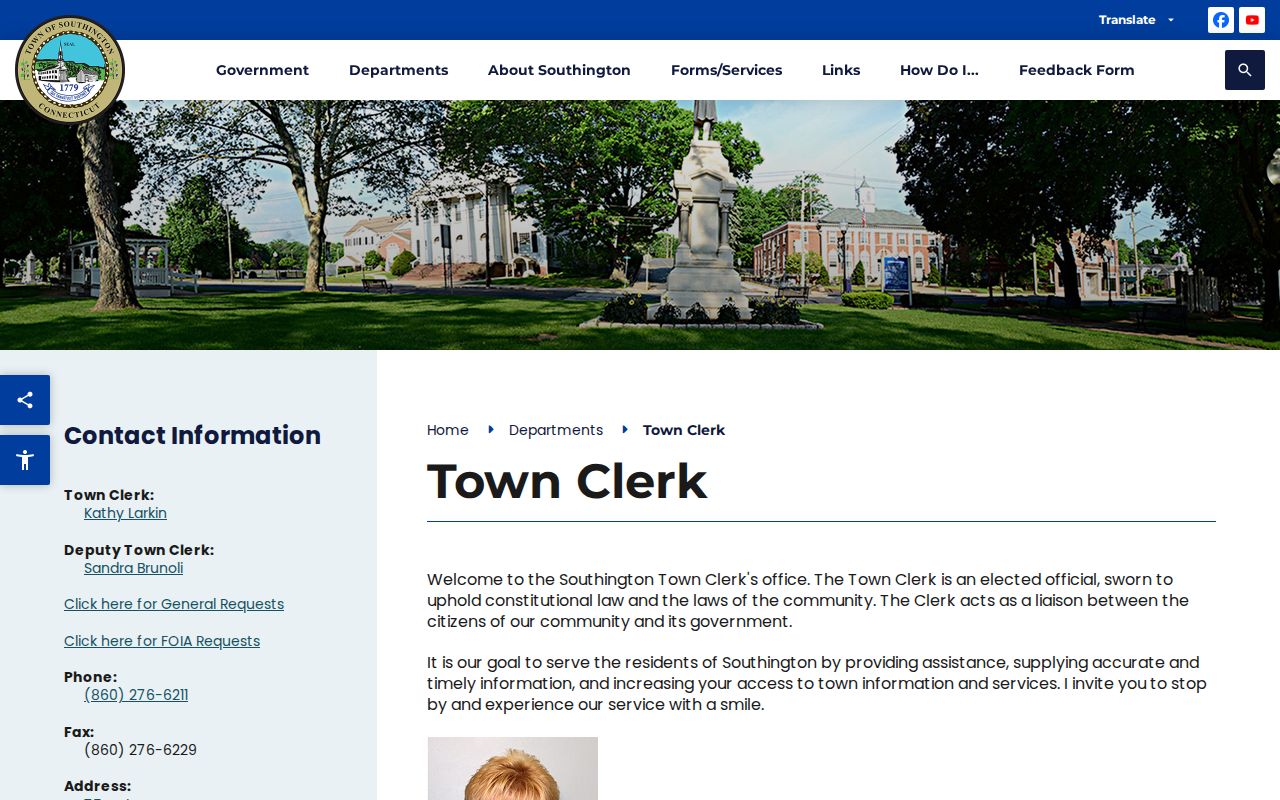
The office link keeps the local records route distinct from statewide court, vital, and voter systems.
Southington Residents Directory Identifier Chain
Names move badly between record systems. Identifiers move better. Vision gives a PID, MBLU, and account/List#; GIS accepts a parcel ID; the Tax Collector uses a Parcel/List#; the Town Clerk uses a book and page; and a court docket uses a location, category, year, number, and suffix. Save each label exactly as shown, with the source and date. That small habit keeps a promising match from becoming a guess.
The identifier chain also explains why a search can appear to stop. A parcel card may show a deed clue but not the scanned instrument. A map may show a nearby lot but not prove a legal boundary. A voter lookup may show a named status result but not a street roster. A city directory may show a past address but not a current owner. Each record adds one link, then another source tests it.
- PID
- A parcel identifier used by the Vision card and GIS bridge.
- MBLU
- Map, lot, and unit values used to locate a parcel or condo unit.
- List#
- The assessor account label, also echoed as Parcel/List# in the tax search.
- Book and page
- A recorded-document reference used to move from a parcel card to a Town Clerk deed.
- Criss-cross directory
- An address-led historical source that can connect a street to a listed household.
Southington Property Search for Residents
The Vision Government Solutions database is the fastest place to test a Southington address or owner name. Its Property Lookup control offers Address, Owner, Acct#, MBLU, PID, and All modes. MBLU opens Map, Lot, and Unit boxes, each with a seven-character limit. The Street Listing link provides an alphabetical parcel browse when a spelling or partial address fails, and Sales Search is a separate top-level route.
The card separates location from mailing address and may show an owner or co-owner, values, building details, land, outbuildings, and sale history. A tax-record owner is not a complete resident list. A mailing address can be outside the property, and a trust or other entity can appear in the owner field. Treat the card as an anchor for the next source, not as proof of every person at the premises.
| Address | Use the property street and number, such as the portal's normalized format. |
|---|---|
| Owner | Search the current owner field and preserve spelling or co-owner variants. |
| Acct# | Use the assessor's account or List# when a name or address is unclear. |
| MBLU | Enter Map, Lot, and optional Unit values for a parcel or unit context. |
| PID | Carry the parcel identifier into GIS and related record requests. |
The sample Southington parcel card shows how a book/page clue and sale history sit beside building and valuation fields. The card's map disclaimer matters: it is an assessment tool, not a survey.
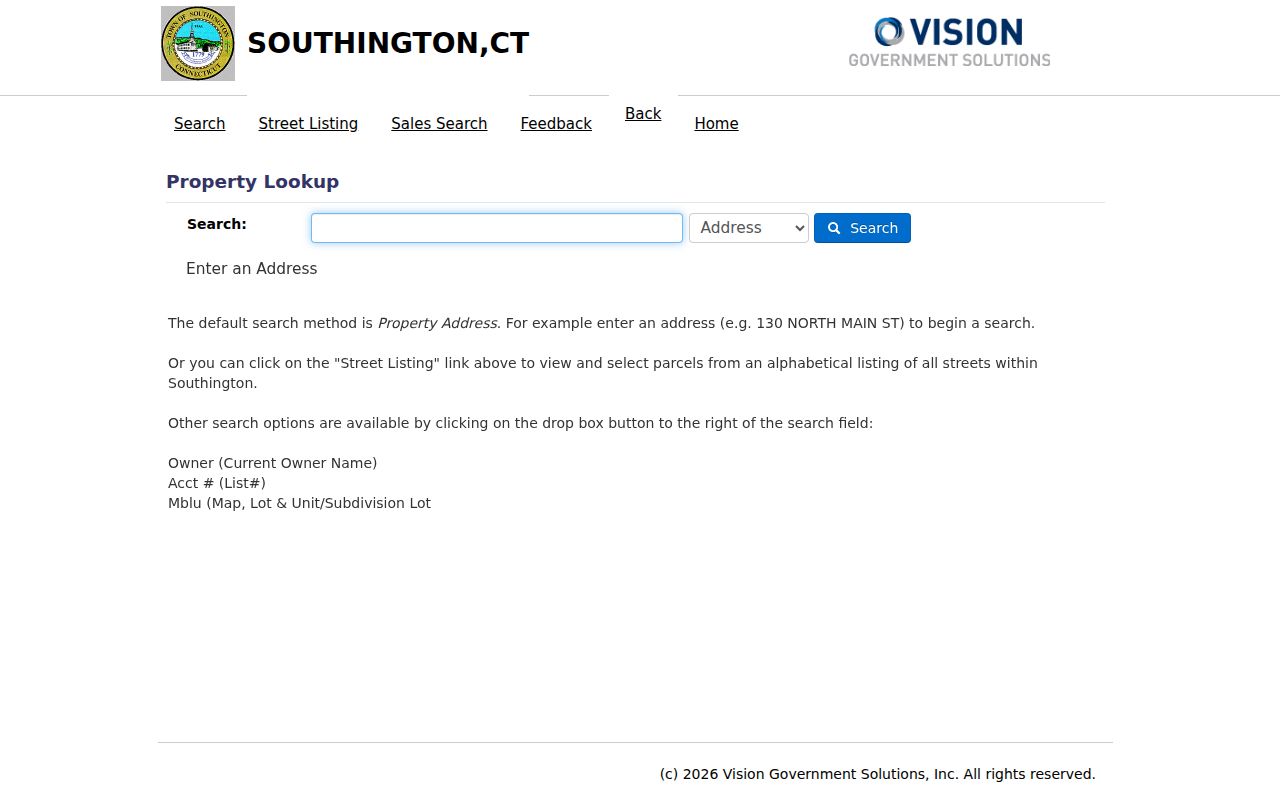
The Vision search view makes an address the starting key, while the next record supplies the legal or historical detail.
Southington GIS for a Resident Directory Search
After finding a parcel, open the public Tighe & Bond Southington GIS viewer. Its search prompt accepts Name, Address, or Parcel ID. A result row can expose an index, complex, unit, owner, and address, then lead to Parcel Details or View Details. The map is useful for seeing relationships that a text result hides.
Use Adjacent for touching parcels, Find Abutters for a neighbor set, and Abutter Distance when the relation depends on a measured span. Add Parcel, Remove Parcel, Clear Abutters, Print Labels, and Export List help preserve a dated working set. The viewer also offers layers for zoning, voting locations and districts, ZIP codes, flood, sewer, soils, historic resources, roads, and parcel annotation. Layer dates differ, and the map is approximate, so verify names and legal ownership in Vision and Town Clerk records.
Southington's geography makes this step more useful than a generic map. Plantsville, Milldale, Marion, and Southington center can appear as village or postal labels in older sources. Keep the village name beside the modern address rather than treating a label change as a new household.
Southington Deeds Behind a Directory Record
A book and page on a parcel card can turn an owner clue into a recorded-document search. The local route is the Southington Town Clerk and the Cott Systems RECORDhub land-record portal. The no-subscription service metadata begins March 23, 2020, and the separate Land Records plan begins February 20, 2021. Those are plan dates, not a clean statement of every historical index or image year. The date-availability rows did not render in the research session.
RECORDhub distinguishes an index from an image and a free plan from paid image or print paths. When online access stops, the Town Clerk's copy form asks for up to six volume/page pairs. A mailed request goes to PO Box 152 with payment and a stamped envelope; the form also gives fax 860-276-6229. The Town Clerk copy baseline is $1 per page. A certified copy and a portal print are not the same product.
| Route | Best use | Limit to keep in mind |
|---|---|---|
| RECORDhub index | Locate a name, instrument, date, or book/page clue | Plan, redaction, watermark, and image gates can differ |
| Town Clerk copy form | Request known volume/page citations by mail or fax | No turnaround promise appears on the inspected form |
| PropertyCheck alerts | Watch for matching recorded names and variants | Free alert service, not a full deed-history search |
PropertyCheck lets an account holder enter first, middle, last, spouse, and name variants and choose email or text alerts. That is a useful consumer-safety and ownership notice, but it does not replace reading the instrument.
Current Sources for Southington Residents
Modern Southington resident directories are a set of narrow records, not one master file. The Vision card is strongest for the current tax owner and parcel. The voter lookup can check a named registration status and address context. Deeds show recorded parties and legal descriptions. Tax results show a dated bill trail. City Squared adds permit and certificate history at an address. Together they provide leads, while each source keeps its own rules.
| Source | Who It Lists | Keeper | Access |
|---|---|---|---|
| Vision parcel card | Current owner or co-owner | Southington Assessor | Free web search |
| SOTS voter lookup | Named registration status and address context | Connecticut Secretary of the State | Free named lookup |
| RECORDhub index | Grantors, grantees, and recorded parties | Town Clerk / Cott Systems | Index and plan-based images |
| GEMs tax search | Billed names, parcels, and payment fields | Southington Tax Collector | Free dated search |
| City Squared history | Permit, inspection, and certificate leads | Building Department | Public property lookup, FOIA fallback |
The right question controls the right source. A property card can answer who the tax record names, not who is present today. A voter result can answer a registration question, not identity. A deed can answer who signed a conveyance, not why they signed it. For a one-person verification path, the Southington resident lookup workflow keeps those distinctions side by side.
The Southington Voter Lookup Boundary
Connecticut's public voter lookup is useful when a named registration question is at hand. The prior form capture used town, last name, first name, and date of birth. A result can provide status and polling or residence context, but the lookup is not proof of identity and it is not a free street-by-street household roster. Southington registrars maintain local registration, while the Secretary of the State runs the centralized system.
A broader voter file is a different access channel. The official request form calls for a written request, CSV delivery, a $300 payment, and a certification of permitted civic, scholarly, journalistic, political, or governmental use. It restricts private or commercial use, marketing, solicitation, and harassment. Protected voters, full date-of-birth details, Social Security numbers, driver's-license data, and safety addresses stay outside an ordinary search. The current portal also met bot protection during research, so field labels should be checked in the live form.
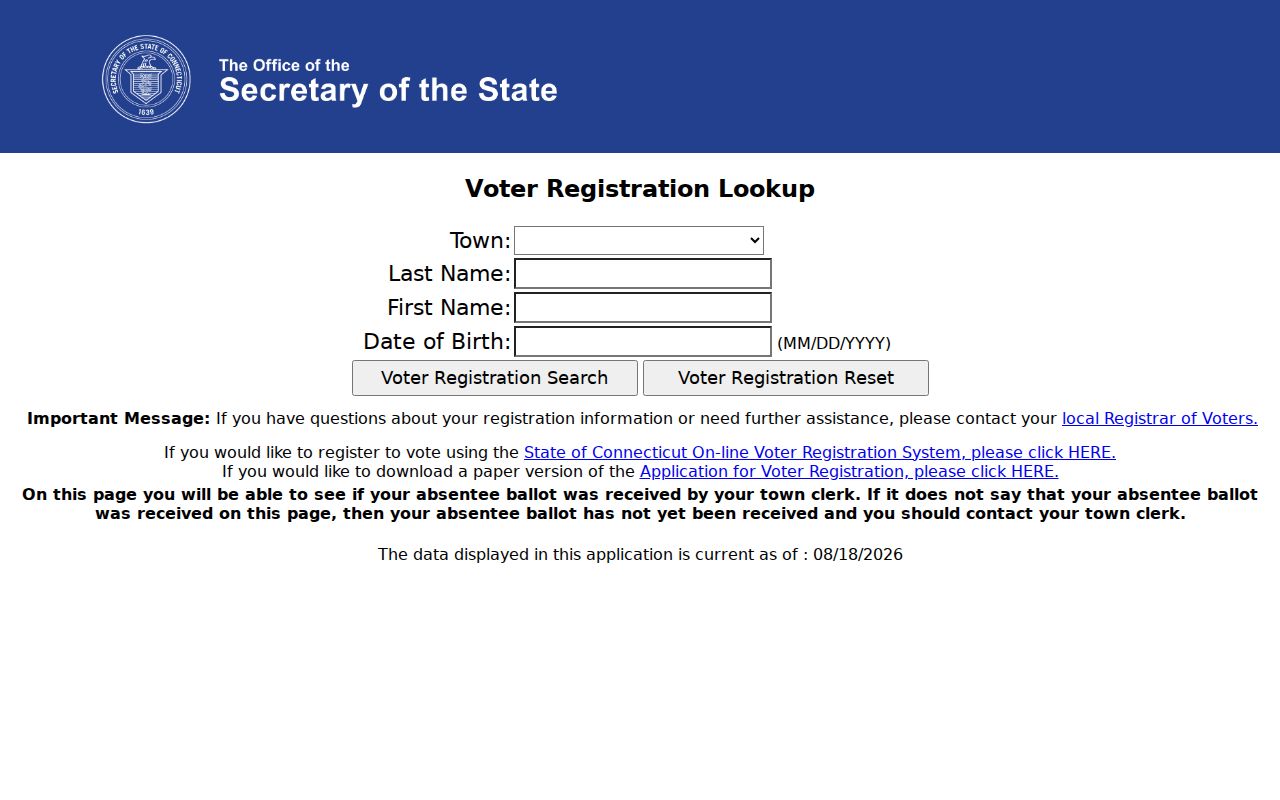
The Connecticut voter lookup is best read as one named status result inside a wider records trail.
Southington Court and Probate Trails
Courts add a name, docket, location, and case relationship that property records cannot. Southington civil, family, and small-claims matters are tied to the New Britain Judicial District. The Civil Inquiry party search requires a last name and can add a first name, location, category, case type, sort order, and match mode such as Starts With, Contains, Is Equal To, or Sounds Like. A property-address search accepts a town, partial street, ZIP, property type, and status.
Criminal and motor-vehicle dockets route through Bristol Geographical Area 17. Its defendant search uses last name, first initial, birth year, year range, location, and category. The public docket is not a criminal-history certificate. Probate follows a third route: the Cheshire-Southington lookup covers estates and trusts from January 5, 2011 forward, while earlier coverage is incomplete and archival material reaches back to the older Probate Court era. The public row can show case number, name, type, and district. Documents may require interested-party access.
For a federal case, the District of Connecticut and PACER are separate from the state court search. Verify a match with the clerk, docket number, filing date, and party role before treating it as evidence about a person.
Southington Vital Records by Event
Vital records answer an event question, not a general resident question. The Southington Town Clerk handles qualifying local requests, while the Department of Public Health State Vital Records Office supports statewide searches and state-only record types. Birth and fetal-death records under 100 years are restricted under C.G.S. §7-51. Marriage and death records are generally available to people 18 and older under C.G.S. §7-51a, with Social Security numbers and other confidential fields treated separately.
Town applications list the person or event, requester identity, relationship, ID, copy choice, and payment. The research captured $15 wallet or $20 full-size town birth copies, $20 town death and marriage copies, and a $30 state birth copy. State processing can take up to 12 weeks. Requests may use mail or in-person routes, and DPH names VitalChek as the approved third-party ordering service, with extra vendor fees and record-type limits. A newspaper, index, or family tree can guide a search, but it is not a certified copy.
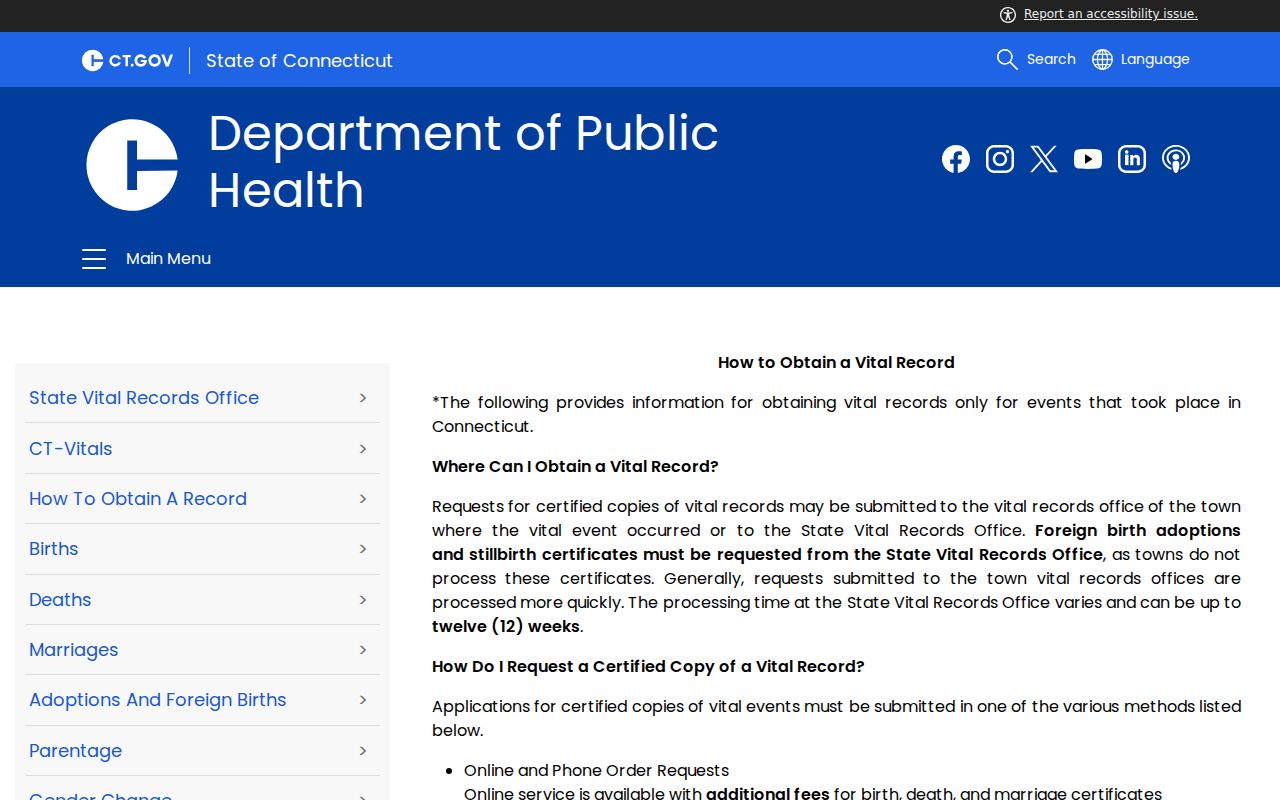
The Connecticut vital-record guidance explains which office and form fit the event before a request is sent.
Southington's Historical Directory Shelf
Southington's historical directory trail is anchored by the Price, Lee & Co. series cited for 1869-1962 and the confirmed 1882 volume. An old entry can give a name, occupation, house or boarding note, spouse or widow notation, and a village clue. It does not carry a PID, ZIP, tax value, phone number, or current owner. The Local History Room at Southington Public Library is the practical shelf and staff route for volumes, phonebooks, maps, newspapers, and obituaries.
For the collection details and entry vocabulary, use the Southington city directory page. A directory year can then be paired with a census snapshot, deed, probate file, cemetery record, or newspaper notice. Plantsville, Milldale, Marion, and Southington center may appear under different labels, so preserve the printed wording as well as the modern town name.
Southington Family and Civic Leads
Some of the best resident clues are built for memory rather than for a current name search. Southington High yearbooks run from 1951-1989, Lewis High's Chronicle from 1926-1990, and the library also holds the Southington Ladies' Aid reunion record from 1884-1932. These collections can reconnect a former classmate, place a household in a school year, or show an organization without claiming that the person still lives at the old address.
The Local History Room, Southington Historical Society, Barnes Museum, FamilySearch Center, churches, and cemetery custodians extend the trail. Oak Hill Cemetery has a search and find-a-grave route, while parish records and memorial files need a direct request. The Connecticut State Library can identify town reports, probate, maps, directories, and archive groups. Annual reports and civic histories add dated context for a person, estate, or neighborhood while leaving private member lists private.
Private Edges of a Southington Residents Directory
Public records have sharp edges. A property card does not disclose every occupant. A voter result does not expose a full date of birth or every person at an address. Connecticut's DPPA rules limit motor-vehicle data, and sealed, juvenile, expunged, protected, adoption, and confidential parentage records do not become open through a broad name search. Private organization rosters, utility accounts, delivery records, and personal phone data are not part of the ordinary public chain.
A person facing a qualifying safety risk may use Connecticut's Address Confidentiality Program under C.G.S. §§54-240 through 54-240o, and a protected voter may use the safety statement process under C.G.S. §9-50(d). Those programs can change how an address is displayed, but they do not erase every source record. A correction belongs with the custodian that created the record.
Lawful personal use. Use public records for genealogy, civic research, estate work, or personal safety. Do not use a name or address trail to stalk, harass, intimidate, or harm anyone.
Requesting Southington Records Offline
When an index ends, go to the office that holds the record. The Connecticut Freedom of Information Act, C.G.S. §§1-200 through 1-243, asks a requester to name the agency, identify the record and date range, and say whether inspection or copies are wanted. A written request is required for copies. Municipal copying can be charged up to $0.50 per page, and an appeal to the Freedom of Information Commission generally has a 30-day window.
For land records, use the Town Clerk counter, phone (860) 276-6211, mail or fax copy route, and the book/page citation. For permits, the Building Department and a focused town request are the fallback. For vital records, use the exact Town Clerk or DPH form with ID and relationship proof. Court copies go to the New Britain, Bristol, Cheshire-Southington, or federal clerk as appropriate. For older names and addresses, ask the library, Historical Society, Barnes Museum, FamilySearch Center, or State Library about in-person, phone, email, or copy access.
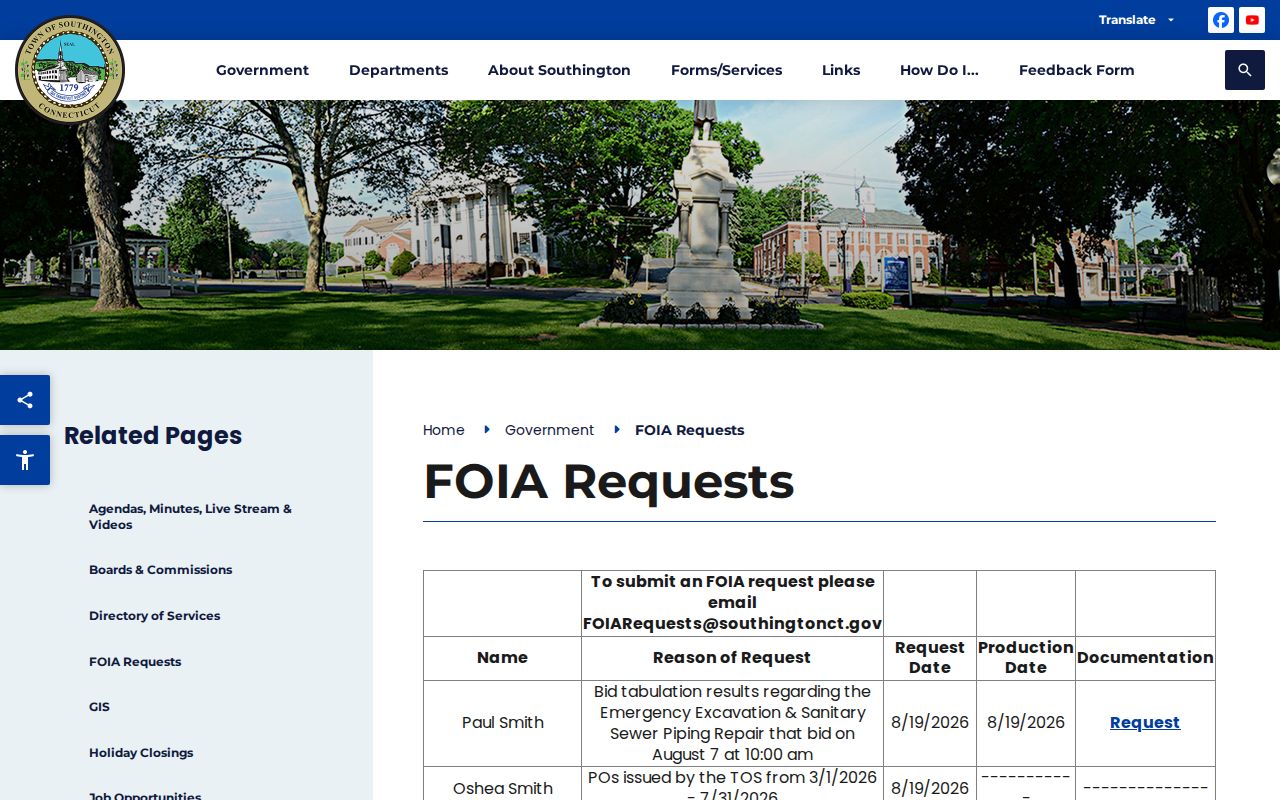
The Southington FOIA request log shows the town's production route and helps a requester name a narrow record set.