
Finding Southington Residents Through Records
Start with the clue least likely to change. An address opens the Vision parcel card. A PID opens the GIS map. A book-and-page reference points to a recorded deed. A full name helps too, but names need a town, a date, an address, or a family link to separate one person from another. Southington has no county recorder. Hartford County keeps no land records counter. The Town Clerk serves as the local recording hub, while the assessor, Tax Collector, registrars, courts, and libraries each hold a separate piece.
The trail can label someone as an owner of record, a registered voter, a court party, an estate case, a business connection, or a historical directory listing. Those labels are not interchangeable. Pick the record that fits the question at hand, then confirm the answer with a second office. The public trail will not show every person who uses an address, a private phone number, or a protected residence. One source rarely closes the case alone.
- Run the Vision property search by address or owner and save the PID, MBLU, account/List#, and both situs and mailing labels.
- Open the same parcel in the Tighe & Bond viewer to inspect its shape, nearby parcels, ZIP layer, voting layers, and map notes.
- Use the book/page or party name in Southington Town Clerk records, RECORDhub, the voter lookup, or the court index as the question requires.
- For an older household, ask the library for city directories, yearbooks, newspapers, and maps, then pair a directory address with a census year.
- When a record is not indexed, name the exact custodian and date range in a focused request instead of asking for every record about a person.
Where Southington Resident Records Live
Southington's records map is local and split. Connecticut abolished county government as a land-record layer. Skip the hunt for a Hartford County recorder. The Town Clerk at Town Hall acts as the local recording officer and registrar. The Assessor keeps the parcels. Registrars maintain voter rolls, while state courts, DPH, and archives hold records that never touch a town counter. Each office confirms a different link. Call first when a form, an eligibility rule, or an old book reference is unclear. A phone answer can point you to the right custodian, but it cannot replace the record itself.
Southington Town Clerk
75 Main Street, Southington, CT 06489
Mail: PO Box 152
(860) 276-6211
Southington Assessor
75 Main Street, Southington, CT 06489
Parcel and valuation questions
(860) 276-6205
Connecticut voter lookup
Local registrars at Town Hall
Registrar phone: (860) 276-6268
SOTS: (860) 509-6100
Forms and hours change. The official Southington Town Clerk page lists the local counter, its forms, hours, and record duties.
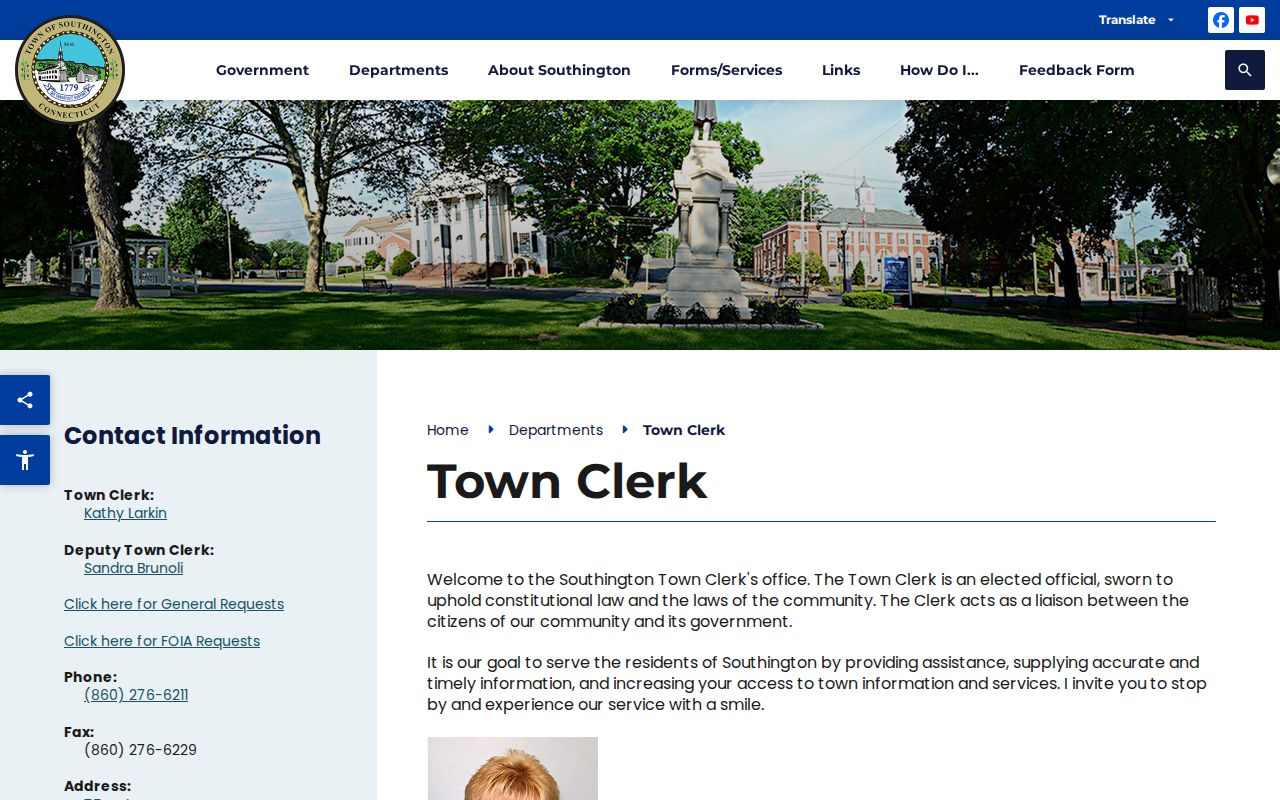
The town link stays separate from statewide court, vital, and voter systems.
Southington Residents Directory Identifier Chain
Names travel badly between record systems. Identifiers travel better. Vision issues a PID, an MBLU, and an account or List number. GIS takes the parcel ID. The Tax Collector works from a Parcel or List number. The Town Clerk files by book and page. A court docket needs a location, category, year, number, and suffix. Copy every label exactly as shown, with its source and date. That small habit keeps a promising match from turning into a guess.
The chain explains why searches stall. A parcel card shows a deed clue but not the scanned instrument. A map shows a nearby lot. A voter lookup names a status. Neither proves a boundary or prints a street roster. A city directory gives a past address but no current owner. Each record adds one link, and a second source tests it.
- PID
- A parcel identifier used by the Vision card and GIS bridge.
- MBLU
- Map, lot, and unit values used to locate a parcel or condo unit.
- List#
- The assessor account label, also echoed as Parcel/List# in the tax search.
- Book and page
- A recorded-document reference used to move from a parcel card to a Town Clerk deed.
- Criss-cross directory
- An address-led historical source that can connect a street to a listed household.
Southington Property Search for Residents
The Vision Government Solutions database is the quickest way to test a Southington address. It also works for an owner name. Its Property Lookup offers Address, Owner, Acct#, MBLU, PID, and All modes. MBLU opens Map, Lot, and Unit boxes with a seven-character limit each. When spelling fails, try the Street Listing link for an alphabetical parcel browse. Sales Search runs as a separate top-level route.
The card splits location from mailing address. It may show owners and co-owners, values, building details, land, outbuildings, and sale history. A tax record is not a resident list. The mailing address can sit outside the property. A trust or other entity can fill the owner field. Treat the card as an anchor for the next source. It is not proof of everyone at the premises.
| Address | Use the property street and number, such as the portal's normalized format. |
|---|---|
| Owner | Search the current owner field and preserve spelling or co-owner variants. |
| Acct# | Use the assessor's account or List# when a name or address is unclear. |
| MBLU | Enter Map, Lot, and optional Unit values for a parcel or unit context. |
| PID | Carry the parcel identifier into GIS and related record requests. |
The sample Southington parcel card shows a book/page clue beside sale history, building data, and valuation fields. Read the map with care. It is an assessment tool, not a survey.
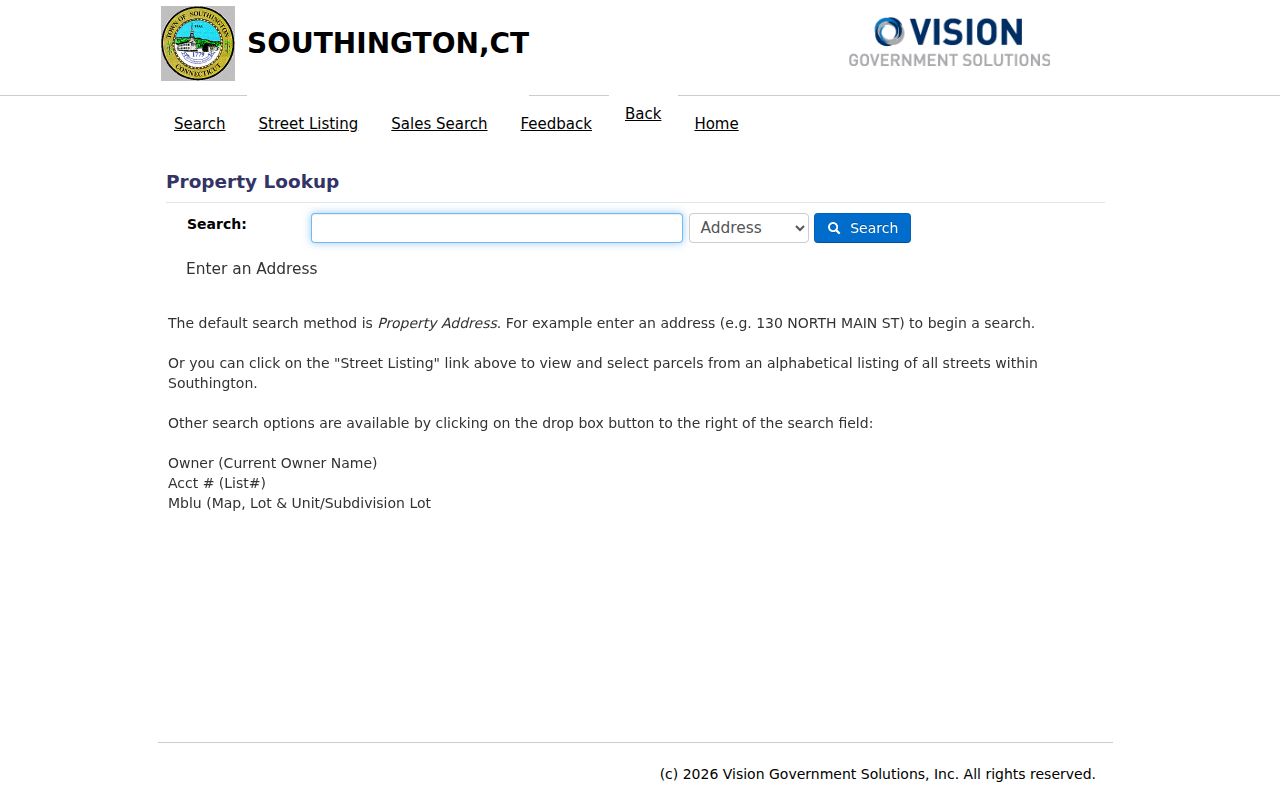
An address is the starting key. The Vision search view opens there, and the next record in the chain supplies the legal or historical detail.
Southington GIS for a Resident Directory Search
A parcel number unlocks more than a tax card. Open the public Tighe & Bond Southington GIS viewer. The map does what a text record cannot. The search prompt takes a Name, an Address, or a Parcel ID. A result row may list an index, complex, unit, owner, and address. Links open Parcel Details or View Details. Relationships jump out on a map that stay buried in a list.
Neighbor tools sit at the heart of a residents directory search here. Adjacent shows parcels that touch yours. Find Abutters builds a neighbor set around a point. Abutter Distance narrows it to a measured span. Add Parcel, Remove Parcel, Clear Abutters, Print Labels, and Export List let you save a working set for later. You can print it too. Layers add zoning, voting locations and districts, and ZIP codes. Flood zones, sewer, soils, historic resources, roads, and parcel annotation join them. Layer dates vary, and the map stays approximate. So confirm names and legal ownership against Vision and Town Clerk records.
Southington's geography rewards this extra step. Plantsville, Milldale, Marion, and the town center show up as village or postal labels in older sources. Keep the old village name beside the modern address. A label change is not a new household.
Southington Deeds Behind a Directory Record
A book and page on a parcel card is a strong owner clue. It can turn that clue into a recorded-document search. The local route runs through the Southington Town Clerk. It also uses the Cott Systems RECORDhub land-record portal. The no-subscription service metadata begins March 23, 2020. The separate Land Records plan begins February 20, 2021. Treat those as plan dates. They are not a clean statement of every historical index or image year. Older deeds may need the clerk's counter.
RECORDhub separates an index from an image, and a free plan from paid image or print paths. That distinction matters. When online access stops, use the Town Clerk's copy form. It accepts up to six volume and page pairs at once. Mail it to PO Box 152 with payment and a stamped return envelope. Fax orders go to 860-276-6229. Copies run $1 per page. A certified copy and a portal print are not the same product. Choose based on what the record must prove.
| Route | Best use | Limit to keep in mind |
|---|---|---|
| RECORDhub index | Locate a name, instrument, date, or book/page clue | Plan, redaction, watermark, and image gates can differ |
| Town Clerk copy form | Request known volume/page citations by mail or fax | No turnaround promise appears on the inspected form |
| PropertyCheck alerts | Watch for matching recorded names and variants | Free alert service, not a full deed-history search |
PropertyCheck works differently. An account holder enters a first, middle, and last name, plus a spouse and name variants, then picks email or text alerts. It serves well as a consumer-safety and ownership notice. Still, it does not replace reading the instrument itself.
Current Sources for Southington Residents
Modern Southington resident directories are a set of narrow records, not one master file. The Vision card is strongest for the current tax owner and the parcel itself. The voter lookup answers a named registration question with address context. Deeds reveal recorded parties and legal descriptions. Tax results give a dated bill trail. City Squared adds permit and certificate history at an address. Each source sets its own rules, so treat them as leads that complement one another.
| Source | Who It Lists | Keeper | Access |
|---|---|---|---|
| Vision parcel card | Current owner or co-owner | Southington Assessor | Free web search |
| SOTS voter lookup | Named registration status and address context | Connecticut Secretary of the State | Free named lookup |
| RECORDhub index | Grantors, grantees, and recorded parties | Town Clerk / Cott Systems | Index and plan-based images |
| GEMs tax search | Billed names, parcels, and payment fields | Southington Tax Collector | Free dated search |
| City Squared history | Permit, inspection, and certificate leads | Building Department | Public property lookup, FOIA fallback |
The right question controls the right source. A property card names the tax-record owner, not who lives there today. A voter result answers a registration question, not identity. A deed shows who signed a conveyance, never why. The Southington resident lookup workflow keeps those distinctions side by side for one person.
The Southington Voter Lookup Boundary
Connecticut's public voter lookup helps when the question is a named registration. The form asks for town, last name, first name, and date of birth. A result can show status plus polling or residence context. It is not proof of identity. Nor is it a free street-by-street household roster for building a residents directory. Southington registrars maintain local registration, while the Secretary of the State runs the centralized system.
The broader voter file is a different channel entirely. Its official request form calls for a written request, CSV delivery, and a $300 payment. The requester must certify a permitted civic, scholarly, journalistic, political, or governmental use. Private or commercial use, marketing, solicitation, and harassment are restricted. Protected voters, full date-of-birth details, Social Security numbers, driver's-license data, and safety addresses stay outside any ordinary search. Field labels can shift, so read the live form before relying on them.
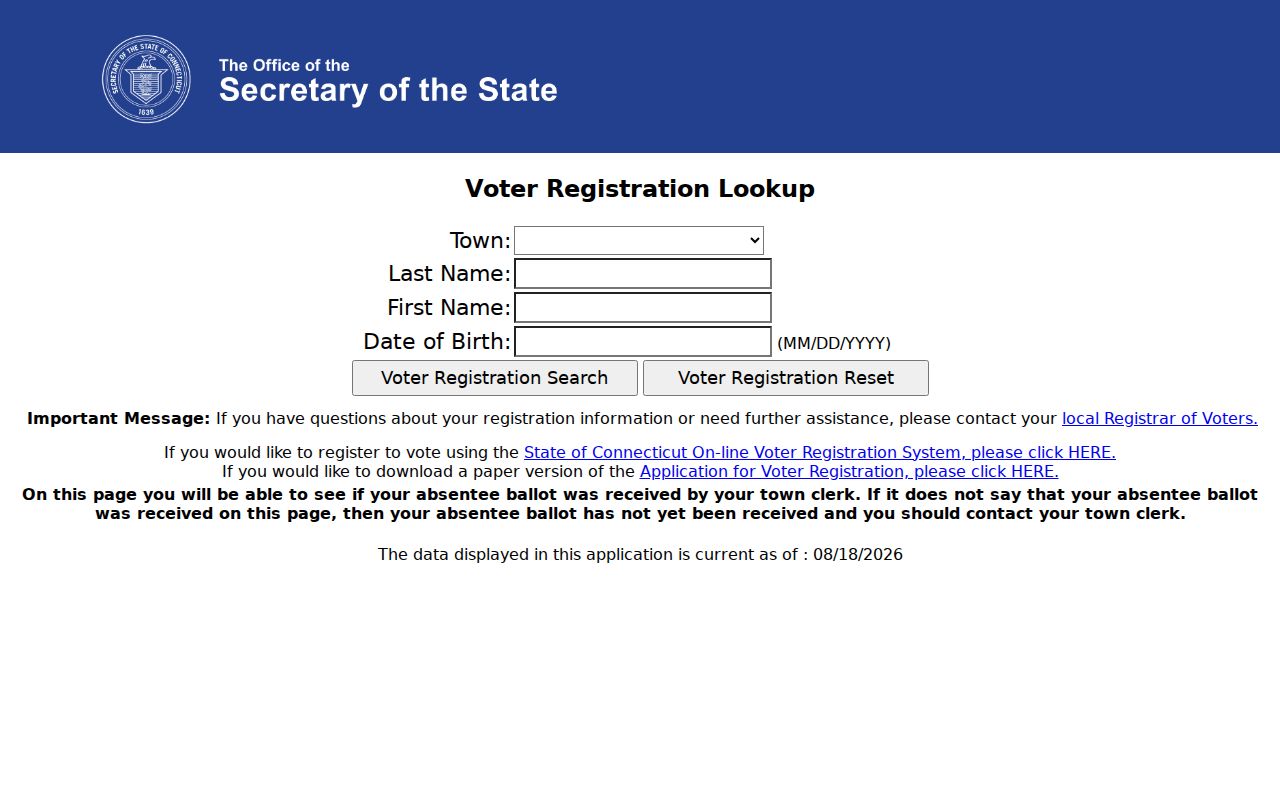
The Connecticut voter lookup works best as one named status result sitting inside a wider records trail, so treat it as a single point rather than the whole answer.
Southington Court and Probate Trails
Court files tell a different story than property rolls. A docket adds names, relationships, and a place in a case. Southington civil, family, and small-claims matters sit in the New Britain Judicial District. The Civil Inquiry party search needs a last name. A first name, location, category, case type, and sort order can narrow it. Match modes include Starts With, Contains, Is Equal To, and Sounds Like. A separate property-address search takes a town, partial street, ZIP, property type, and status.
Criminal and motor-vehicle dockets take another path. They route through Bristol Geographical Area 17. Its defendant search works from a last name, first initial, birth year, or a year range. Location and category can be added. The public docket is not a criminal-history certificate. Probate runs on a third track. The Cheshire-Southington lookup covers estates and trusts from January 5, 2011 forward. Earlier coverage is incomplete, though archival material reaches back to the older Probate Court era. A public row lists case number, name, type, and district. But documents may require interested-party access.
Federal cases sit outside this system. The District of Connecticut and PACER stand apart from any state court search. So before treating a match as evidence about a person, verify it with the clerk, the docket number, the filing date, and the party role.
Southington Vital Records by Event
Vital records answer an event question. They do not settle a general resident question. The Southington Town Clerk handles qualifying local requests. The Department of Public Health State Vital Records Office backs statewide searches and state-only record types. Birth and fetal-death records under 100 years are restricted under C.G.S. §7-51, while marriage and death records open to people 18 and older under C.G.S. §7-51a. Social Security numbers and other confidential fields stay separate.
Town applications ask for the person or event, requester identity, relationship, ID, copy choice, and payment. Fees vary by format. A town birth copy costs $15 in wallet size or $20 full-size, town death and marriage copies run $20 each, and a state birth copy is $30. State processing can take up to 12 weeks. Requests move by mail or in person. DPH names VitalChek as its approved third-party ordering service, though extra vendor fees and record-type limits apply. A newspaper, index, or family tree can guide a search, but none is a certified copy.
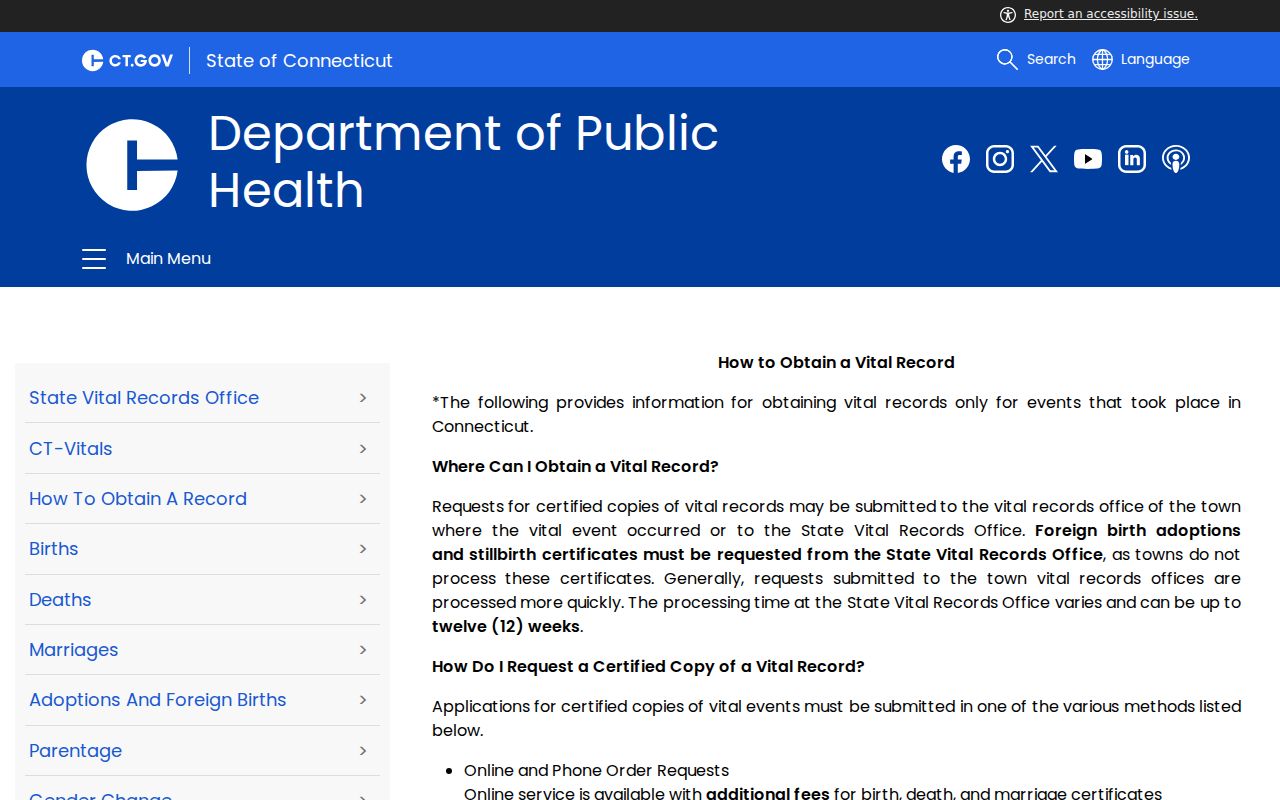
The Connecticut vital-record guidance explains which office and which form fit the event, so a requester knows where a birth, marriage, or death record lives before sending anything.
Southington's Historical Directory Shelf
Old directories anchor Southington's historical trail. The Price, Lee & Co. series spans 1869-1962, with a confirmed 1882 volume. An old entry can carry a name, occupation, a house or boarding note, a spouse or widow notation, and a village clue. No PID or ZIP appears. Nor a tax value, phone, or current owner.
The Local History Room at Southington Public Library is the practical shelf. Staff there hold volumes, phonebooks, maps, newspapers, and obituaries. The Southington city directory page covers the details. Then pair a directory year with a census snapshot, deed, probate file, cemetery record, or newspaper notice.
Village labels shift over time. Plantsville, Milldale, Marion, and Southington center may appear under different names in print. Preserve the printed wording as well as the modern town name.
Southington Family and Civic Leads
Some of the strongest leads in the Southington residents directory world were made for memory, not for a quick resident lookup. The library holds Southington High yearbooks from 1951-1989 and Lewis High's Chronicle from 1926-1990, plus the Southington Ladies' Aid reunion record covering 1884-1932. A yearbook can place a household in a given school year. It can reconnect old classmates too. None of it promises the person still lives at the old address.
The trail widens from there. The Local History Room, the Southington Historical Society, the Barnes Museum, a FamilySearch Center, churches, and cemetery custodians all hold pieces of the city directory record. Oak Hill Cemetery offers a search and find-a-grave route, while parish records and memorial files take a direct request. The Connecticut State Library helps identify town reports, probate files, maps, directories, and archive groups. Annual reports and civic histories add dated context for a person, an estate, or a neighborhood, and they leave private member lists private.
Private Edges of a Southington Residents Directory
Every Southington residents directory has limits worth knowing. A property card names owners, not every occupant. A voter record hides the full date of birth and everyone at an address. Connecticut's DPPA rules restrict motor-vehicle data. Sealed, juvenile, expunged, protected, adoption, and confidential parentage records never open up through a broad resident lookup. Utility accounts and delivery records sit outside the public chain entirely. So do personal phone data and private organization rosters.
Safety programs fill part of the gap. A person facing a qualifying threat may join Connecticut's Address Confidentiality Program under C.G.S. §§54-240 through 54-240o. A protected voter can use the safety statement process under C.G.S. §9-50(d). These programs change how an address appears, though they cannot erase every source record. Any correction belongs with the custodian that created the record in the first place.
Lawful personal use. Use public records for genealogy, civic research, estate work, or personal safety. Do not use a name or address trail to stalk, harass, intimidate, or harm anyone.
Requesting Southington Records Offline
Once an index runs dry, the office that holds the record is the next stop. Connecticut's Freedom of Information Act, C.G.S. §§1-200 through 1-243, sets the rules. A requester must name the agency, describe the record and its date range, and state whether inspection or copies are wanted. Copies call for a written request. Municipal offices may charge up to $0.50 per page for copying, and appeals to the Freedom of Information Commission generally must land within 30 days.
Land records live at the Town Clerk counter. Reach it by phone at (860) 276-6211, by mail or fax for copies, and bring a book and page citation if you have one. Permits fall back to the Building Department through a focused town request. Vital records demand the exact Town Clerk or DPH form, plus ID and proof of relationship. Court copies belong to the New Britain, Bristol, Cheshire-Southington, or federal clerk, whichever fits the case.
Older names and addresses need different doors. Ask the library, the Historical Society, the Barnes Museum, a FamilySearch Center, or the State Library. Each can help in person, by phone, by email, or with copies.
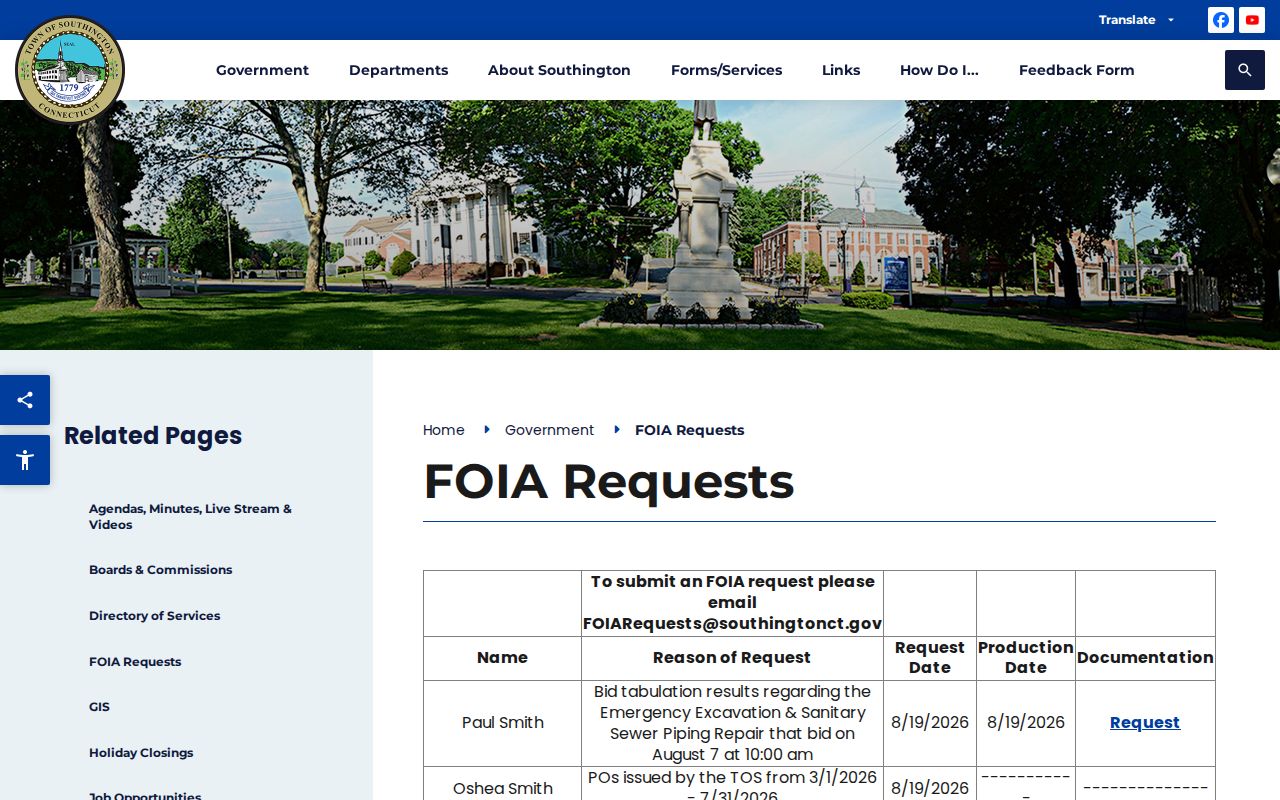
The Southington FOIA request log lays out the town's production route. Reading it first helps any requester name a narrow record set.